
Mevia OS: No Apps, Decentralized OS, Technology, Software, Mobile, Wireless – Pitch
February 7, 2026
Patent Trial and Appeals Board Uphelds Patent Claims in the MEVIA Portfolio
June 2, 2026April 24, 2026 — Florida-based EGLA Corp., owned by inventor Dr. Edwin A. Hernandez-Mondragon, has filed a new patent infringement lawsuit in the U.S. District Court for the Western District of Texas (Austin Division) against Stingray Group Inc. (f/k/a Stingray Digital Group Inc.), Stingray Music USA, Inc., and Mood Media LLC (f/k/a Mood Media Corporation).
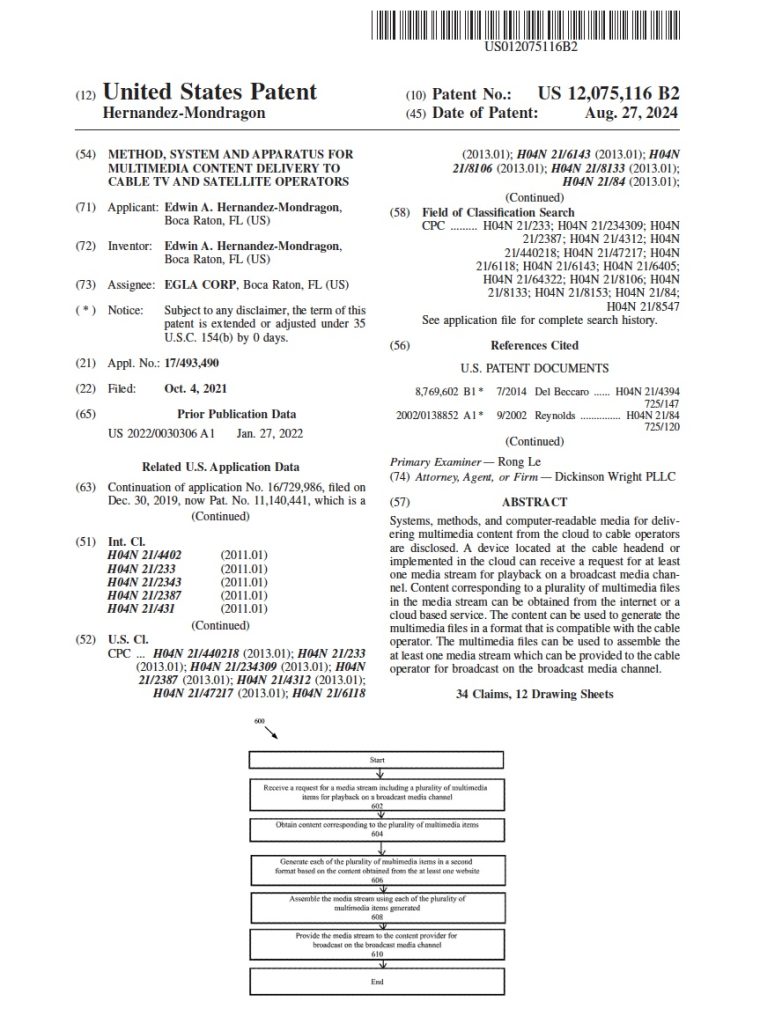
The complaint asserts U.S. Patent No. 12,075,116 B2 (issued August 27, 2024), titled “Method, System and Apparatus for Multimedia Content Delivery to Cable TV and Satellite Operators.” The patent covers a cloud-based system that dynamically converts web-sourced multimedia content (HTML templates, images, live feeds) into broadcast-ready audio-visual streams using headless browser rendering, screen-capture video generation, caching, and multicasting — with automatic “self-refreshing” when source websites change.
EGLA is launching MEVIA MUSIC an artificial intelligence platform for music and digital signage content distribution, as well as Cable, IPTV, and OTT Platform music for Smart TVs.

What the Patent Claims
At its core, Claim 1 describes a streamlined workflow:
- A caching unit receives a request from a multicasting server for a media stream in a specific format.
- The system pulls content from internet websites, renders webpages via a browser, and uses a headless rendering engine to generate multiple screen captures.
- It assembles video frames from those captures, combines them with audio tracks, and saves the resulting multimedia items.
- The platform then multicasts the stream to cable, satellite, IPTV, or in-store display systems.
- When changes are detected on the source websites (e.g., updated playlists, RSS feeds, or social media), the system automatically retrieves new screen captures and reassembles updated multimedia items.
This technology enables efficient, real-time delivery of dynamic music channels and visual content without traditional hardware encoders or satellite uplinks.
The Accused Platforms
Plaintiff alleges that both defendants are infringing the patent through their commercial streaming services:
- Stingray’s UbiquiCAST OSE2 platform — used by over 700 cable and IPTV operators worldwide to deliver music and audio-visual channels to more than 400 million subscribers. The complaint cites internal Stingray documents (JIRA tickets) referencing the GalaxieStillPic generator, multicast addressing, playlist updates, and AWS-based caching — all allegedly matching the patented process.
- Mood Media’s Mood Harmony / Mood Visuals / Harmony CMS / ProFusion media players — a cloud-hosted digital signage and in-store audio-visual system used by retail stores, hotels, restaurants, and other commercial venues. Public Mood Media documentation (Harmony support PDFs) details HTML templates, AWS CloudFront caching, mDNS-based device discovery, live feeds (Twitter/X, RSS, weather), automatic content propagation, and screenshot/monitoring features that Plaintiff maps directly to the patent claims.
Detailed claim charts attached as Exhibits D and E to the complaint walk through every element of Claim 1 against each platform.
Historical Background and Alleged Unauthorized Use
The lawsuit traces back to 2012, when Dr. Hernandez began working with DMX Music (then headquartered in Austin) to modernize its outdated music-delivery infrastructure. After Mood Media acquired DMX in 2013 and Stingray later acquired DMX assets in 2014, Plaintiff alleges the defendants gained access to his proprietary technology, source code, and servers installed at cable head-ends — without ever taking a license. Multiple NDAs and licensing discussions (2017–2019) are cited, along with the continuity of key executives between the companies.
Plaintiff claims the defendants’ continued use of the technology has enabled significant revenue growth while depriving EGLA Corp. of compensation for the patented inventions.
Parallel Litigation in Florida
This Texas filing is closely related to an earlier lawsuit filed by Dr. Hernandez and EGLA Corp. in the Southern District of Florida (Case No. 1:24-cv-21226-RAR). That case includes trade-secret misappropriation, breach of contract, and patent claims based on the same patent family. While the patent counts in Florida are currently stayed pending IPR proceedings on three parent patents, the non-patent claims have survived motions to dismiss and summary judgment. Discovery in the Florida action is complete, providing a rich factual record that Plaintiff expects to leverage in Texas.
What’s Next
The Western District of Texas complaint seeks a permanent injunction, reasonable royalty damages, enhanced damages for willful infringement, and attorney fees. Venue is particularly strong because Mood Media maintains its headquarters in Austin.
The new suit underscores the ongoing battle over cloud-based multimedia delivery technology in the music and digital-signage industries. With a fresh continuation patent, detailed public claim charts, and extensive discovery already completed in the parallel Florida case, EGLA Corp. is poised to press its claims on two fronts.
Stay tuned for updates as the case proceeds. This post is for informational purposes only and is not legal advice.