
ITC and Trade Secrets, Concealment, the Statute of Limitations Question, and Where to Find the Forms
July 1, 2026
Youtube Implementation of a Model Context Protocol
August 9, 2026
A practitioner’s perspective on updating reasonable royalty analyses after IPR Final Written Decisions, with scenario-based treatment of the Georgia-Pacific factors and a roadmap for reopened discovery after a 12–18 month stay.
The Problem Nobody Budgets For
When a district court stays patent litigation pending inter partes review, most litigants treat the stay as a pause button. It is not. It is a fault line. The case that comes back from the PTAB is never the same case that left, and the damages report sitting in the file — served before the stay, built on pre-stay financials, pre-stay licenses, and pre-stay validity assumptions — is almost always obsolete on the day the stay lifts.
The reason is structural. A reasonable royalty under 35 U.S.C. § 284 is constructed around a hypothetical negotiationbetween a willing licensor and a willing licensee at the time infringement began, in which the patent is assumed valid and infringed. Before an IPR, that validity assumption is a legal fiction that the defendant’s expert quietly discounts at every turn — in the comparable license analysis, in the bargaining-position narrative, in the apportionment. After a Final Written Decision (FWD), the fiction has been stress-tested by the very tribunal Congress designed to kill weak patents. Whatever survives is no longer merely presumed valid; it has been battle-tested against the best prior art the defendant could find, with the defendant estopped under § 315(e) from raising those grounds (or grounds it reasonably could have raised) again in district court.
That changes the economics. It changes the Georgia-Pacific analysis. And because a year to eighteen months of real-world commerce has elapsed, it changes the factual record itself. Below I walk through what a damages expert must update, which Georgia-Pacific factors move and in which direction under four outcome scenarios, and what discovery should be reopened when the stay lifts.
Part I: The Georgia-Pacific Factors That Move After an IPR
Of the fifteen Georgia-Pacific factors, roughly half are directly sensitive to an IPR outcome. The rest are sensitive to the passage of time during the stay — a distinct but equally important driver of the update, addressed in Part III.
Factor 1 — Royalties received by the patentee for licensing the patent-in-suit. Any license executed during the stay must be added to the dataset. More subtly, licenses executed before the IPR were negotiated under validity uncertainty; a license negotiated after an FWD confirming the claims reflects a validity-risk-free (or reduced-risk) rate. The expert must now segment the comparable license set by when each license was signed relative to the validity milestone, and adjust accordingly. A pre-IPR license at rate X may understate the post-FWD hypothetical rate, because the licensee in that earlier deal was paying for a probabilistic asset.
Factor 2 — Rates paid by the licensee for comparable patents. Same temporal segmentation applies to the defendant’s own licensing history, which may have grown during the stay.
Factor 4 — The licensor’s established policy and marketing program. A patentee who has now defended its claims through IPR and continued licensing has demonstrably reinforced an enforcement-backed licensing policy. This factor tends to firm up the licensor’s resistance to discounting.
Factor 5 — The commercial relationship between licensor and licensee. Competitive dynamics may have shifted during the 12–18 month stay: divestitures, acquisitions, market entries and exits. The relationship as of the hypothetical negotiation date does not change, but the book of evidence illuminating it does.
Factors 8, 9, 10, and 11 — Commercial success, advantages over old modes, the nature of the invention, and the extent of the infringer’s use. These are where surviving-claim composition matters most. If the IPR trimmed the claim set, the expert must re-map the accused functionality to the surviving claims only. Damages tied to features covered exclusively by cancelled claims must come out; the technical expert’s infringement read and the damages expert’s apportionment must be re-synchronized claim by claim. Conversely, an FWD often generates a rich evidentiary record — expert declarations, institution decisions, the Board’s own findings about what the prior art did not teach — that sharpens the Factor 9 “advantages over old modes and devices” narrative. The Board’s articulation of why the claims are non-obvious is, functionally, a government-authored statement of the invention’s technical contribution.
Factor 13 — The portion of the realizable profit credited to the invention. Apportionment must be recalculated against the surviving claim set and against updated financials. If the broadest claims survived, apportionment may hold or improve; if only narrow dependent claims survived, the footprint of the patented contribution within the accused product may shrink.
Factor 15 — The hypothetical negotiation itself. This is the factor where everything converges, and it deserves its own discussion under each scenario.
Part II: Four Scenarios
Scenario A: 100% of Challenged Claims Survive
This is the patentee’s best case, and the damages update is almost entirely upward.
At the hypothetical negotiation, the willing licensee is assumed to accept validity — but real-world comparable licenses embed real-world validity discounts. When every challenged claim survives, the expert can credibly argue that the litigation-risk haircut baked into pre-IPR comparables should be unwound for purposes of benchmarking the hypothetical rate. A patent that emerged from IPR with all claims intact is a categorically stronger asset than the same patent the day before institution, and the negotiating leverage of the licensor (Factors 4, 5, and 15) rises accordingly.
Second-order effects compound this. The § 315(e) estoppel dramatically narrows the defendant’s trial invalidity case, which strengthens the patentee’s settlement posture — a dynamic that itself informs how comparable settlements should be weighted. Continued infringement after an FWD confirming validity also feeds the willfulness analysis; while enhancement under § 285/§ 284 is legally distinct from the royalty calculation, the notice record post-FWD is far cleaner, and juries hear the same story. The damages period, meanwhile, has extended by the length of the stay: 12–18 additional months of accused sales flow directly into the royalty base, and prejudgment interest has continued to accrue.
Practically, the supplemental report in this scenario adds: (1) the extended sales base; (2) a validity-premium adjustment to the comparable license benchmarks; (3) the Board’s factual findings as Factor 9/10 support; and (4) updated interest calculations.
Scenario B: 50% of Claims Survive
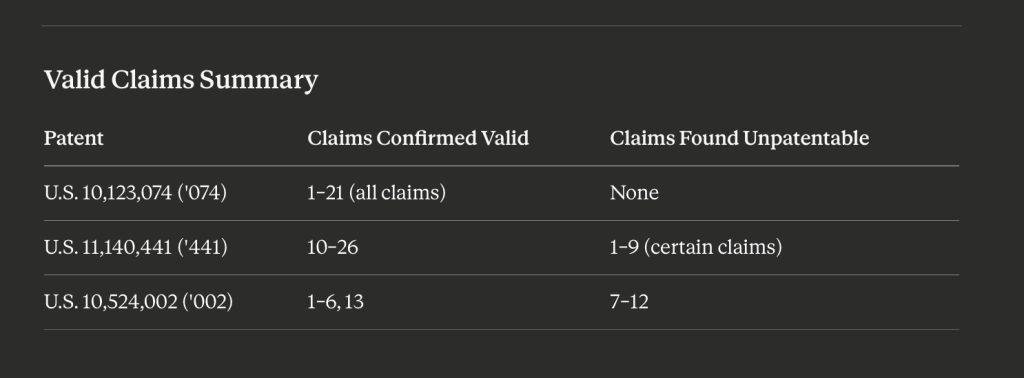
Here the work is surgical rather than directional. The headline question is not “how many claims survived” but “whichclaims survived, and do the accused products still read on them?”
If the surviving half includes the independent claims the infringement case was built on, the damages model may be nearly untouched on the liability-mapping side, and the patentee still captures much of the Scenario A validity premium — the surviving claims went through the same crucible. The cancelled claims matter mainly if the defendant argues they covered specific accused features; the expert must show the royalty base and apportionment never depended on them.
If, instead, the survivors are a mix of independent and dependent claims that cover a narrower slice of the accused functionality, the update is more invasive. The royalty base may need to be re-scoped (which accused products or modules still infringe a surviving claim), apportionment under Factor 13 must be re-derived from the narrower technical footprint, and Factors 9–11 must be re-argued around the surviving claims’ contribution rather than the original full set. The defendant will argue for a mechanical haircut — “half the claims died, so halve the damages” — and the expert’s job is to demolish that arithmetic: damages track the economic footprint of the surviving claims in the accused product, not a claim count. A single surviving independent claim that reads on the core accused functionality can support the entire original royalty; fifty cancelled dependent claims that added nothing to the infringement read subtract nothing.
One more wrinkle: if any surviving claims were amended during the IPR, intervening rights under § 252/§ 307(b) can cut off pre-amendment damages for those claims entirely. The damages period must be bifurcated claim-by-claim around the amendment date.
Scenario C: 10% of Claims Survive
Now the case has been fundamentally reshaped, and the damages expert should assume the entire model must be rebuilt from the surviving remnant outward.
The threshold question is existential: do the accused products infringe any surviving claim? If the survivors are narrow dependent claims, the infringement contentions must be amended, and the damages model inherits whatever narrowing occurs there. The royalty base may collapse from “all accused products” to “the subset of products or usage scenarios practicing the surviving limitations.” Apportionment becomes the whole ballgame — the smallest salable patent-practicing unit analysis, feature-level valuation (surveys, conjoint analysis, regression on feature-differentiated pricing), and Factor 13 dominate the report.
Counterintuitively, the surviving 10% is not worthless leverage. Those claims survived the defendant’s best prior art and carry § 315(e) estoppel; the defendant’s trial invalidity case may be gutted even though most claims fell. A narrow-but-bulletproof claim reading on a commercially essential feature can still anchor a substantial royalty — but the expert must build that value story from the feature up, not from the portfolio down. The comparable license analysis also needs re-examination: prior licenses covering the full (now mostly cancelled) claim set may require downward adjustment for scope, and the defendant will press hard on that point.
Scenario D: Total Loss
If all asserted claims are cancelled and the FWD is affirmed (or unappealed), damages on that patent are moot — cancelled claims are void ab initio, and under Fresenius-line reasoning even a pre-existing infringement judgment can be swept away if not yet final. The damages work shifts to salvage: any other asserted patents in the case that were not challenged or that survived their own IPRs, and preservation of the record for Federal Circuit appeal of the FWD. If the case involved multiple patents and only some were annihilated, the report must strip every dollar attributable to the dead patents and re-run the analysis on the survivors — which is really Scenario B or C wearing a different hat.
Part III: What Discovery Should Be Reopened After a 12–18 Month Stay
The stay does not just suspend the case; it ages the record. Rule 26(e) imposes a continuing duty to supplement, but a diligent patentee should move affirmatively to reopen targeted discovery rather than rely on the defendant’s supplementation instincts. The categories below are the standard menu.
Updated financial and sales data. The single most important item. The damages period now runs through trial, and 12–18 months of accused-product revenue, unit sales, pricing, cost, and margin data did not exist when the original report was served. Courts routinely permit this; refusing it would freeze damages at an artificially early date.
New and amended license agreements. Both sides’ licensing activity during the stay is fair game — new comparables, renewals, settlements in parallel litigation. A settlement or license the defendant signed during the stay involving similar technology can transform the Factor 2 analysis. Likewise, any license the patentee executed post-FWD is powerful Factor 1 evidence carrying the validity premium discussed above.
Corporate transactions and product changes. Divestitures, acquisitions, product redesigns, feature deprecations, and new product launches during the stay all affect the royalty base and the commercial-relationship factors. If the defendant redesigned around the patent mid-stay, that both truncates the base going forward and — under Factor 9 and the design-around prong of the hypothetical negotiation — quantifies the cost of not taking a license, which is affirmative evidence of the patent’s value.
Supplemental 30(b)(6) depositions on financials and marketing. Short, targeted depositions limited to the stay period: updated sales figures, new product lines, marketing of accused features, and any internal valuation of the patents (which may have occurred precisely because of the IPR outcome — internal post-FWD risk assessments are a goldmine).
The IPR record itself. The FWDs, expert declarations, institution decisions, and the defendant’s own petition arguments are now part of the universe. A defendant who told the PTAB the prior art rendered the invention trivial, and lost, has created cross-examination material for its trial damages expert who will inevitably argue the invention adds little value. Positions taken in the petitions can be mined for judicial-estoppel and impeachment purposes.
Supplemental expert reports on both sides. The practical vehicle for all of the above. Most courts, on lifting a stay, will enter a short supplemental schedule: updated interrogatory responses and document productions, limited fact depositions, supplemental opening and rebuttal expert reports, and supplemental expert depositions. The patentee should propose that schedule affirmatively in the joint status report accompanying the motion to lift the stay — it frames the reopening as routine housekeeping rather than a contested expansion.
Prejudgment interest. Not discovery, strictly, but a mandatory recalculation. Twelve to eighteen months of additional accrual at the prime or T-bill rate, compounded, on a base that has itself grown, is real money — and it is money the defendant’s strategic decision to seek IPR and a stay generated.
Part IV: The Argument in One Paragraph
The defendant will say the stay changed nothing about the hypothetical negotiation, which is anchored to the date of first infringement. That is true as to the date and false as to the evidence. The hypothetical negotiation is a construct informed by all reliable evidence, including post-negotiation facts admissible under the “book of wisdom” — and a Final Written Decision confirming validity, new licenses reflecting post-FWD rates, a redesign quantifying avoidance costs, and eighteen months of continued infringing sales are exactly the kind of later-acquired wisdom courts allow the fact-finder to consult. A damages report that ignores the IPR outcome is not conservative; it is wrong in whichever direction the FWD cut. The update is not optional. It is the case.
This post is for general informational purposes and reflects common practice in patent damages work; it is not legal advice, and outcomes depend heavily on the specific claims, record, and jurisdiction involved.