
Filing at the ITC, Part 2: What Actually Goes Into a Section 337 Complaint
July 1, 2026
ITC and Trade Secrets, Concealment, the Statute of Limitations Question, and Where to Find the Forms
July 1, 2026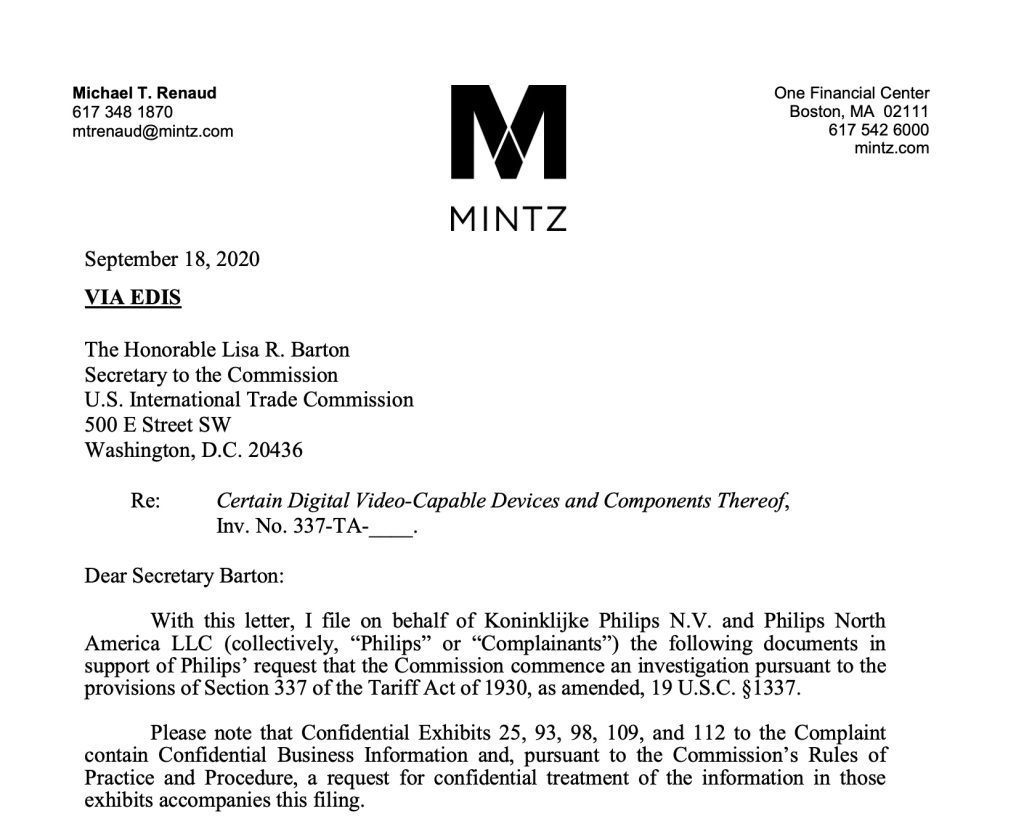
This is Post 3 of a three-part series on litigating intellectual property and trade secret disputes at the U.S. International Trade Commission (ITC). Post 1 covers why the ITC has become a favored venue. Post 2 walks through the mechanics of actually filing a complaint. Post 1 looks specifically at how streaming, connected-TV are using Section 337 — and what that means for a domestic industry built on licensing, and finally, on Trade Secrets and the ITC
Streaming and connected-device technology has become one of the more active corners of the ITC’s docket. The pattern makes sense: the hardware side of streaming — smart TVs, set-top boxes, streaming players, speakers, remotes — is manufactured almost entirely overseas and imported into the U.S. at enormous volume, which is exactly the fact pattern Section 337 was built to police for filing at the ITC.

The docket, by technology layer
Adaptive bitrate streaming. DivX filed a complaint against TCL’s video processing devices and smart televisions, alleging infringement of patents covering the technique used to adaptively stream multimedia files to consumer electronics over a network connection (Inv. No. 337-TA-1297, instituted 2022). The case illustrates a recurring theme in this space: the asserted technology sits in a codec or streaming-protocol layer that’s licensed broadly across the industry, which tends to make the domestic industry showing turn on licensing and engineering investment rather than manufacturing.
Music and audio streaming. Sonos asserted patents covering music streaming, playback, and distribution against Google, with expert testimony addressing the existence of a domestic industry, the appropriate remedy, and bond. Separately, in the Certain Wireless Audio Systems investigations, patented streaming-audio multimedia technology was asserted to block importation of wireless speakers and other audio systems (Inv. Nos. 337-TA-1010 and 337-TA-1071) — one of several disputes in that family that settled once the ITC’s schedule and exclusion-order exposure were on the table.
Video-capable smart TVs and set-top infrastructure. In a 2026 filing, InterDigital asserted patents against TCL’s video-capable electronic devices, including smart televisions and monitors, seeking a limited exclusion order and cease and desist orders (Inv. No. 337-TA-1495). Universal Electronics brought a similar action naming Roku and TCL entities as respondents over patents implicated in streaming players, televisions, set-top boxes, and remote controllers (complaint filed April 2020). And Roku itself has been a complainant — asserting universal-remote and device-pairing patents against LG and Samsung televisions and remote controls (Inv. No. 337-TA-1263).
Program guides and DVR functionality. Rovi and TiVo pursued ARRIS at the ITC over on-screen programming guide technology used in digital video receivers — a case ARRIS ultimately won after a five-day trial, a reminder that exclusion-order exposure is a two-way risk that has to be underwritten before filing, not just after a favorable claim construction.
Trade secrets, for scale. No streaming-specific trade secret case has produced a headline number yet, but the SK Innovation battery case remains the reference point every practitioner cites: a $1.8 billion settlement following an ITC finding of trade secret misappropriation, driven almost entirely by exclusion-order leverage rather than a money judgment from the Commission itself. It’s not a streaming case, but it’s the number every complainant’s counsel uses to frame client expectations about what an ITC exclusion threat is actually worth in a negotiation.
What the domestic industry requirement looks like in this sector
For patent claims — which is most of what’s listed above — domestic industry has two prongs: a technical prong (does a domestic article actually practice the patent) and an economic prong (significant investment in plant and equipment, significant employment of labor or capital, or substantial investment in engineering, R&D, or licensing). That third economic-prong path — engineering, R&D, or licensing investment — is the one that matters most for a complainant whose business model is IP licensing rather than manufacturing at scale. Where a portfolio owner licenses a large number of patents, Commission precedent requires showing a sufficient nexus between the licensing activity and the specific patents asserted in that investigation, not just an undifferentiated licensing program across the whole portfolio.
For trade secret claims, the domestic industry test is different in kind, not just degree: rather than proving technical + economic prongs tied to a specific patent, the complainant has to show that the threat or effect of the respondent’s conduct is to destroy or substantially injure a U.S. industry, prevent one from being established, or restrain competition. That’s a broader, more fact-intensive showing, and it’s exactly the requirement the Commission has been willing to resolve early and dispositively — sometimes within 100 days of institution — before the parties spend a dime litigating the merits of misappropriation itself.
Building the record before you file
A few things fall out of the case pattern above that are worth internalizing before drafting a complaint in this sector:
- Claim charts have to map to a specific accused implementation, not the standard. Streaming and codec patents are often standard-adjacent (adaptive bitrate delivery, audio compression, remote-pairing protocols). The ITC’s claim chart requirement forces precision about which product feature — not which specification — practices each limitation, which is worth working out well before the complaint is drafted, not during discovery.
- License agreements you intend to rely on for standing or domestic industry have to be produced as exhibits at filing, confidentially if necessary — not held back and introduced later. If a licensing history is central to the domestic industry story (as it typically is for a licensing-driven complainant), that exhibit package needs to be assembled early.
- Respondent geography drives strategy. Every streaming-hardware case above names Asia-based manufacturers or their U.S. import affiliates as respondents. That’s the worldwide-jurisdiction advantage from Post 1 playing out in practice — but it also means service, translation, and coordinating with the respondent’s U.S.-based counsel of record become real logistical considerations from day one.
- Exclusion-order exposure is symmetric. The ARRIS/Rovi outcome is a useful reminder that a well-resourced respondent can and does win these cases outright. The Commission’s public-interest and injury inquiries are not rubber stamps, and a complaint built on a thin domestic industry record risks an early, dispositive loss rather than a negotiated settlement.
- A parallel district court case is not a reason to avoid the ITC — but it does require coordination. Because the ITC’s patent rulings are not preclusive in district court (while its trade secret rulings generally are), a complainant already litigating a patent and trade secret dispute in federal court needs a deliberate view of which claims go where, and when, rather than defaulting to duplicate everything in both forums.
Sample Document
This sample document shows how the complainant will file such investigation to the ITC.(here)
Closing the loop – Filing at the ITC
Read together, these three posts are meant to walk through the full arc: why the ITC has become the preferred venue for stopping infringing imports (Post 1), how a complaint actually gets built and filed under the Commission’s rules (Post 2), and what that looks like in practice for the streaming and connected-device technology that increasingly drives the docket (Post 3). For a patent or trade secret owner sitting on streaming, codec, audio, or device-pairing technology and evaluating where to bring an enforcement action, the ITC’s speed and exclusion-order leverage are real — but they only pay off if the domestic industry and injury record is built correctly from the first filing, not patched together after institution.
This post is for general informational purposes and does not constitute legal advice. Case citations are provided for illustrative purposes; the current procedural posture and outcome of any pending investigation should be confirmed on the Commission’s EDIS database at edis.usitc.gov before being relied upon.