
Filing at the ITC, Part 1: Why Streaming and Media-Tech Companies Are Turning to Section 337
July 1, 2026
Filing at the ITC, Part 3: Lessons from Streaming and Connected-TV Cases
July 1, 2026
This is Post 2 of a three-part series on litigating intellectual property and trade secret disputes at the U.S. International Trade Commission (ITC). Post 1 covers why the ITC has become a favored venue. Post 1 walks through the ITC Process have used Section 337 — and what that means for a domestic industry built on licensing, and finally, on Trade Secrets and the ITC and a final Post 3 on Lesson for Streaming technologies
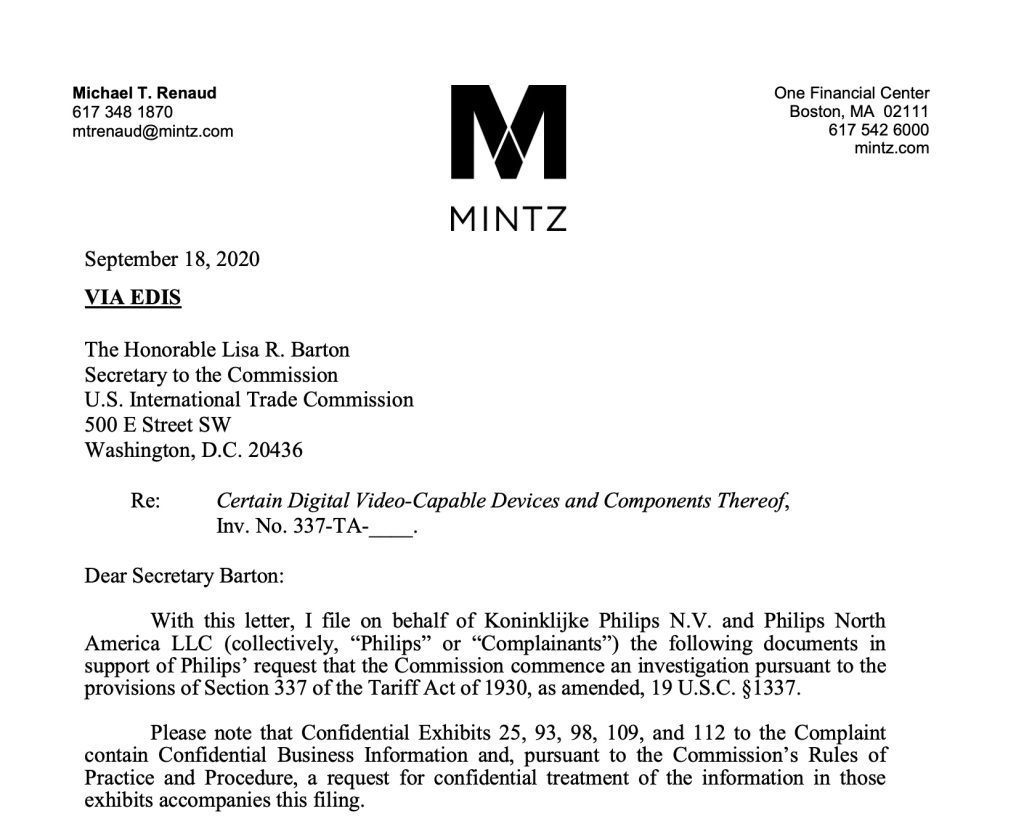
The ITC’s speed advantage comes at a price: its filing rules are unforgiving about form. A complaint that is missing a required exhibit, filed with the wrong number of copies, or lacking a proper confidentiality designation can be bounced back for supplementation before the Commission ever votes on institution — burning days off a clock the complainant can’t get back. Here is what the Commission’s own guidance and rules require.
Where the complaint gets filed
Everything is filed with Docket Services at 500 E Street, S.W., Room 112-A, Washington, D.C. 20436, and documents are only accepted during the Commission’s business hours of 8:45 a.m. to 5:15 p.m. Eastern. Certain public documents can be filed electronically through EDIS (the Commission’s Electronic Document Information System) at edis.usitc.gov, but confidential material generally still has to be filed over the counter in paper form. Every document — public or confidential — must be accompanied by an EDIS cover sheet completed online, which captures the submission date, signatory, and whether the filing contains confidential business information.
The package: what a complete complaint includes
A properly filed Section 337 complaint is really a package of several distinct documents:
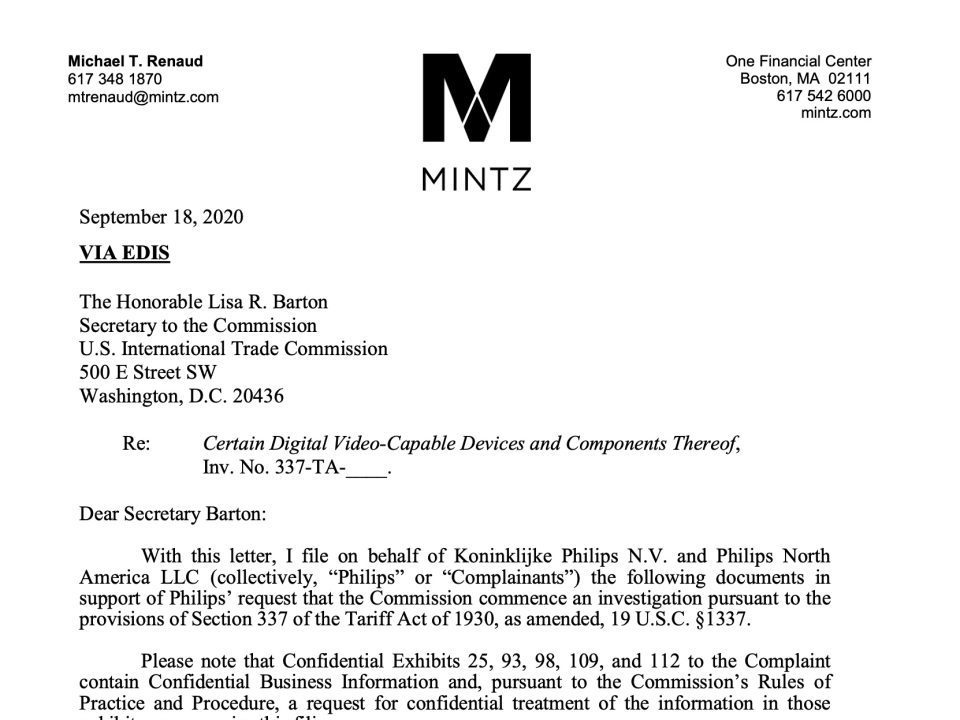
- Cover letter listing everything included in the complaint and identifying any documents for which confidential treatment is being requested.
- Request for Confidential Treatment letter, if applicable, invoking 19 C.F.R. §§ 201.6 and 210.5 to protect Confidential Business Information.
- Statement of Public Interest — capped at five pages including attachments — addressing how the relief requested could affect the public interest.
- EDIS cover sheets, filed separately for the public and confidential versions of the complaint.
- The complaint itself, which must carry an original signature of the complainant or a duly authorized officer, attorney, or agent; be made under oath with a statement attesting to the representations required by the rules; and list the complainant’s (and counsel’s) name, address, and telephone number on the first page.
If a complainant wants confidential treatment for parts of the complaint, current guidance recommends preparing a single public version of the complaint text and pushing the confidential material into the accompanying exhibits, rather than redacting the narrative itself — it cuts down on duplicate copying and reduces the odds of an inconsistency between the public and confidential versions.
Copy counts — and why they matter
The Commission’s copy requirements are exact, and an insufficient number of copies is grounds for rejecting the filing outright:
| Document | Copies required |
|---|---|
| Public complaint | Original (unbound) plus 8 copies |
| Public exhibits | 1 copy, on approved portable media |
| Certified patent/trademark/copyright/mask work/vessel hull registration papers | Original plus 3 copies, on approved portable media |
| Patent prosecution histories and technical references | 4 copies, on approved portable media, in patent cases |
| Confidential complaint (if applicable) | Original (unbound) plus 8 copies |
| Confidential exhibits | 1 copy, on approved portable media |
| Copies for each named respondent | 1 copy of the public complaint and exhibits per respondent |
| Copies for each embassy | 1 copy of the public complaint per foreign respondent’s embassy |
Paper filings before an Administrative Law Judge ordinarily require an original plus six copies; filings before the full Commission require an original plus twelve. The original signed copy, and one additional copy, should not be stapled, bound, or hole-punched (a clip is fine); the remaining copies should be individually bound.
For example ITC 337-TA-3343 (Investigation ongoing):
| Complainant | DivX, LLC | 4350 La Jolla Village Drive, Suite 950, San Diego, 92122, United States of America |
| Respondent | Vizio, Inc. | 39 Telsa, Irvine, 92618, United States of America |
| Respondent | Amazon.com, Inc. | 410 Terry Avenue North, Seattle, 98109, United States of America |
The technical exhibits patent-based complaints can’t skip
If the complaint is built on patent infringement, the Commission’s rules require the complainant to attach, for each asserted patent:
- A certified prosecution history. (here, here)
- Copies of the technical references cited in that prosecution history.
- Claim charts demonstrating infringement of each asserted independent claim. (here)
If the complaint relies on license agreements — either to establish standing or to support the domestic industry showing — those agreements have to be produced as exhibits, confidentially if needed. And once the investigation is instituted, the complainant has an ongoing obligation: any prosecution-history or technical-reference materials that were filed with the Commission but not attached as exhibits must still be served on each represented respondent within five days of that respondent’s notice of appearance and agreement to be bound by the protective order. This is a detail that’s easy to miss and creates real exposure if overlooked — a late or incomplete production here can become its own discovery dispute layered on top of the merits.

Confidentiality: the window before, and the order after
Before a protective order is entered — which typically happens shortly after institution — documents can still be treated as confidential if they’re designated as such, accompanied by a request for confidential treatment, and the Secretary to the Commission agrees they qualify as Confidential Business Information under the governing rules. Once the Administrative Law Judge issues the Protective Order, it will spell out in detail how confidential material must be marked and handled going forward — and, notably, these orders typically give outside counsel access to confidential business information but withhold that access from in-house counsel. That last point is worth flagging early to a client’s internal legal or business team, since it shapes who inside the organization can actually see the other side’s confidential production.
Service: the complaint itself is different from everything else
One rule trips up first-time ITC filers: a complaint should not be served on a proposed respondent unless it’s accompanied by a motion for temporary relief. If the Commission decides to institute an investigation, the Commission itself — not the complainant — serves the complaint and notice of investigation on the named respondents and on the relevant foreign embassies. Everything filed afterward, however, follows the general rule that documents filed with the Commission must be served on all other parties, typically according to the mode of service (often overnight courier) specified in the presiding judge’s Ground Rules.
The institution clock
Once a complaint is filed, the Commission normally decides whether to institute an investigation within 30 calendar days — or within 35 days if the complaint includes a motion for temporary relief. Before that vote, the Commission’s Office of Unfair Import Investigations reviews the complaint for sufficiency and compliance with the rules, and can request supplementation or amendment before the Commission ever votes. That review step is exactly why getting the exhibits and copy counts right at filing matters so much: a defect caught here costs real calendar time in a process that prides itself on speed.
If temporary relief is requested alongside the complaint, there’s a heavier lift: the motion must be supported by a memorandum, by affidavits supporting the factual assertions, and by all evidence the complainant intends to rely on — filed at the time of the motion, not developed afterward. The Commission then decides whether to grant temporary relief no later than the 90th day after institution (or the 150th day in a complex case), applying the same standard the Federal Circuit uses in reviewing preliminary injunctions in district court.
What comes next
Once instituted, the investigation is assigned to an Administrative Law Judge, who sets a target date for completion within 45 days and typically issues a set of Ground Rules that layer additional, investigation-specific requirements on top of the Commission’s own rules — everything from how privilege gets asserted to how many copies of hearing exhibits are required. Those Ground Rules are not boilerplate; they need to be read as closely as the statute itself.
Post 3 turns to substance: how streaming, connected-TV, and audio companies have actually used this process — the patents asserted, the domestic industry theories that worked, and what a licensing-driven portfolio should think about before filing.
This post is for general informational purposes and does not constitute legal advice. Complaint requirements are set out in detail at 19 C.F.R. §§ 210.4, 210.8, and 210.12, and prospective complainants are encouraged to contact the Commission’s Office of Unfair Import Investigations before filing.