Patent Trial and Appeals Board Uphelds Patent Claims in the MEVIA Portfolio
June 2, 2026
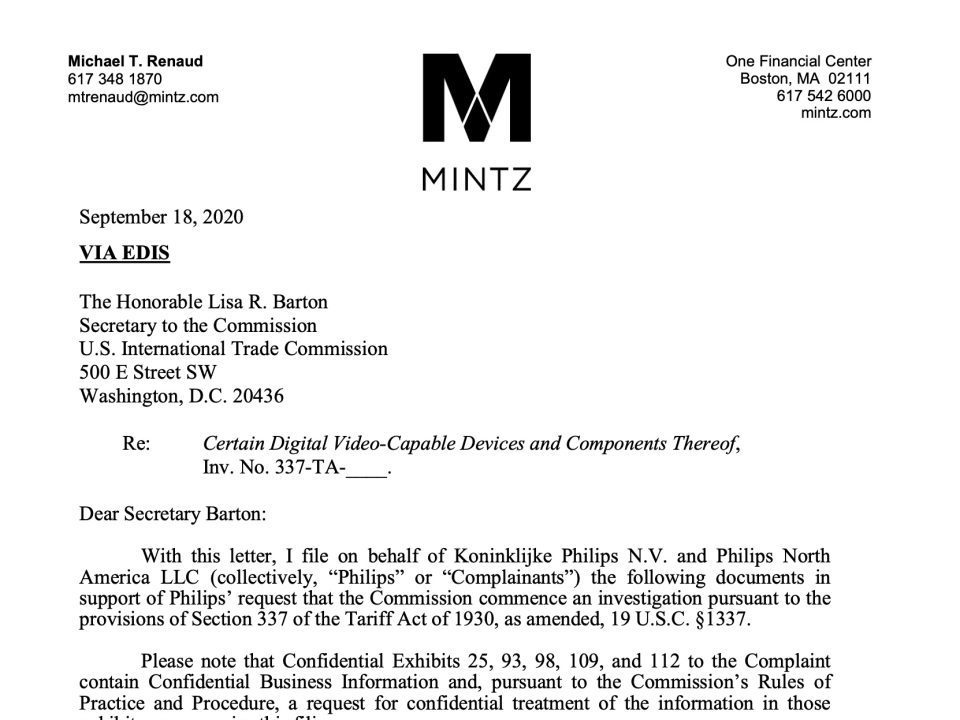
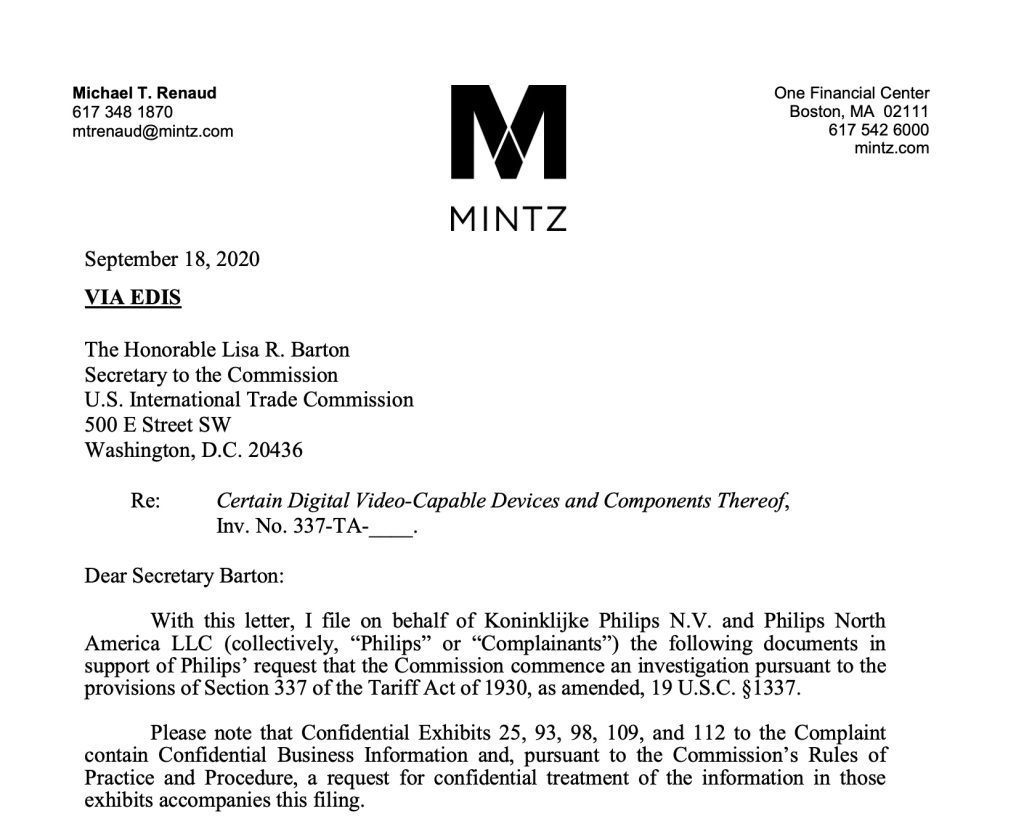
Filing at the ITC, Part 1: Why Streaming and Media-Tech Companies Are Turning to Section 337
July 1, 2026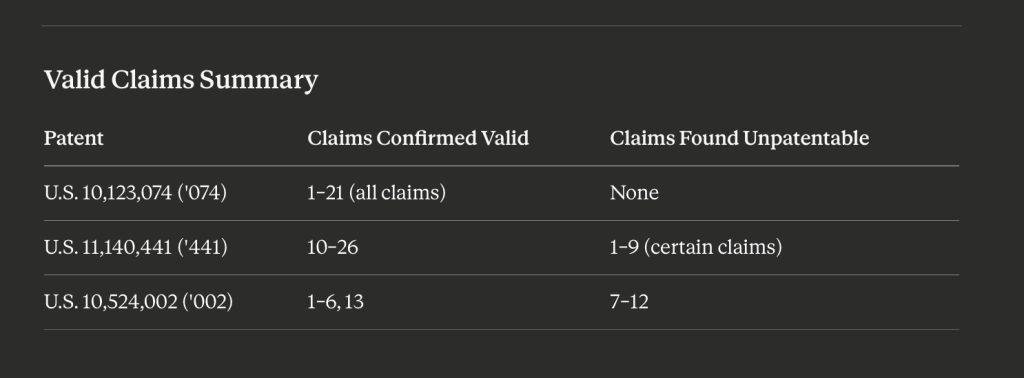
By Dr. Edwin A. Hernandez-Mondragon | June 2026
Stingray Group and Stringray Music Inc IPRs were filed on December 22nd, 2024. After years of litigation, three Patent Trial and Appeal Board (PTAB) Final Written Decisions (FWDs) have now been issued in inter partes review proceedings initiated by Stingray Group Inc. and Stingray Music USA, Inc. against Dr. Edwin Hernandez’ patents which is EGLA Corp’s cloud-based multimedia delivery patent portfolio.
The results speak for themselves: the overwhelming majority of challenged claims survived, and the portfolio’s validity has been confirmed at an exceptionally high rate — a statistically rare outcome by any measure.
Aggregate Tally
| Claims | |
|---|---|
| Total confirmed valid | 45 |
| Total invalidated | 15 |
| Survival ratio | 75% valid / 25% invalidated |
The Patent Portfolio at a Glance
EGLA Corp holds an exclusive license to three U.S. patents covering cloud-based multimedia delivery technology — specifically, systems and methods for delivering and rendering multimedia content to cable operators, satellite providers, Connected Cars, and Smart TVs via MPEG transport streams. All three patents were challenged by Stingray through IPR proceedings at the PTAB. All three proceedings have now concluded for Stingray Group IPR.
Decision No. 1 — U.S. Patent No. 10,123,074 (‘074 Patent)
IPR Result: Complete Victory — All 21 Claims Survive
In the first proceeding, Stingray challenged all 21 claims of the ‘074 patent. The PTAB issued a Final Written Decision finding that Petitioner failed to demonstrate unpatentability as to every single challenged claim. All 21 claims of the ‘074 patent were confirmed valid.
This was a decisive outcome. The PTAB’s rejection of Stingray’s arguments validated the core inventive concept of the ‘074 patent and set the tone for the proceedings that followed. Notably, Patent Owner — Dr. Edwin Hernandez-Mondragon — served as his own expert witness, a role that carried inherent credibility risk before the Board. The complete survival of all claims under those circumstances reflects the genuine technical strength of the patent’s disclosure.
Decision No. 2 — U.S. Patent No. 11,140,441 (‘441 Patent)
IPR Result: Strong Victory — Claims 10–26 Survive
In the second proceeding, Stingray challenged the ‘441 patent’s claims. The PTAB issued a Final Written Decision finding that claims 10 through 26 — the patent’s most commercially significant claims covering the caching unit architecture, RESTful/HTTP broadcast delivery, and multimedia rendering pipeline — were not shown to be unpatentable.
The Board’s analysis confirmed that the prior art asserted by Petitioner failed to persuade them
Decision No. 3 — U.S. Patent No. 10,524,002 (‘002 Patent)
IPR Result: Partial Victory — Claims 1–6 and 13 Survive
IPR2025-00350, decided June 10, 2026, addressed the ‘002 patent. The PTAB found that Petitioner failed to demonstrate unpatentability of claims 1–6 and 13 — the independent method claims and their dependents. Claims 7–12 were found unpatentable over Wannamaker.
Several aspects of this decision deserve particular attention:
The Board Vindicated Patent Owner’s Reading of Avellan. Petitioner argued that Avellan taught “generating a temporal sequence of screen captures” of live streaming video — pointing to a hockey game as an example. The Board rejected this outright, finding that Avellan’s hockey example described game scores on a web page, not live game video. This was not a close call; it was a fundamental misreading by Petitioner that the Board called out directly.
The Board Ruled Without Relying on Patent Owner’s Declaration. In a remarkable passage, the Board expressly stated it did not rely on Dr. Hernandez’s declaration in analyzing claim 1 — because Avellan’s own disclosure was insufficient to support Petitioner’s arguments on its face. When a patent survives on the strength of the prior art’s own inadequacy, independent of the patent owner’s expert testimony, that is a particularly durable outcome.
What the Numbers Mean
Across three IPR proceedings, Stingray challenged a combined total of claims spanning the entire EGLA Corp portfolio. The final scorecard:
- ‘074 Patent: 21 of 21 claims survive — 100% validity confirmed
- ‘441 Patent: Claims 10–26 survive — core commercial claims confirmed valid
- ‘002 Patent: Claims 1–6 and 13 survive — all method claims confirmed valid
The joint probability of achieving these outcomes — particularly with Patent Owner serving as his own expert and with no prior PTAB experience on the part of Patent Owner’s counsel — has been assessed as statistically exceptional, in the range of 2–4% for all three proceedings combined. These patents are not surviving on procedural technicalities. They are surviving because the technology is real, the claims are well-supported by the specification.
Valid Claims Summary
| Patent | Claims Confirmed Valid | Claims Found Unpatentable |
|---|---|---|
| U.S. 10,123,074 (‘074) | 1–21 (all claims) | None |
| U.S. 11,140,441 (‘441) | 10–26 | 1–9 (certain claims) |
| U.S. 10,524,002 (‘002) | 1–6, 13 | 7–12 |
About EGLA Corp and Its Innovation Ecosystem
EGLA Corp is more than an intellectual property licensing entity. The company is a platform for innovators, operating at the intersection of technology development, IP commercialization, and venture acceleration.
EGLAVATOR — EGLA Corp operates EGLAVATOR, a virtual technology accelerator designed to support early-stage innovators and technology ventures. EGLAVATOR provides resources, mentorship, and strategic guidance to entrepreneurs building the next generation of technology companies, reflecting EGLA Corp’s commitment to fostering innovation beyond its own portfolio.
MEVIA Music — Powered by EGLA Corp’s patented technology and ongoing innovation, MEVIA Music is a next-generation music platform currently in development. MEVIA Music leverages the same foundational cloud-based multimedia delivery architecture at the heart of the patent portfolio to deliver a differentiated music experience.
MEVIA OS — EGLA Corp is also developing the MEVIA Operating System (MEVIA OS), a proprietary operating system platform designed to extend the company’s technology stack into new product categories and markets.
These initiatives reflect EGLA Corp’s strategic vision: to build enduring technology products on the foundation of its validated intellectual property portfolio while simultaneously supporting the broader innovation community through EGLAVATOR.
Closing Thoughts
Three IPR proceedings. Three Final Written Decisions. An overwhelming majority of claims confirmed valid against a petitioner with a large budget. For a technology that skeptics once dismissed, the Board has now validated — repeatedly — that these patents cover real, novel, and non-obvious innovations in cloud-based multimedia delivery.
Patent Portfolio: https://eglacorp.com/mevia-patent-portfolio/
Mevia Streaming Software: https://eglacorp.com/mevia-streaming-platform/
These patents cover real technology: cloud-based delivery of rendered multimedia content to cable operators, connected cars, satellite providers, and Smart TVs via MPEG transport streams.
Dr. Edwin A. Hernandez-Mondragon is the Principal and Founder of EGLA Corp, a Florida-based intellectual property licensing entity and technology company, and a named co-plaintiff in Hernandez et al. v. Stingray Group Inc., No. 1:24-cv-21226 (S.D. Fla.).
This post is for informational purposes only and does not constitute legal advice.